
The Sharp Divide: Broad Market Health vs. 491 High-Risk Entities
Poland represents one of the most significant public procurement markets in Central and Eastern Europe, acting as a primary conduit for infrastructure development, digitalization, and the absorption of European Union structural funds. The total analyzed value of 321,352,857,427 PLN across 73,070 contract awards underscores the sheer scale of capital deployment at the national level. However, a deeper structural analysis of the contracting authorities distributing these funds reveals a distinct bifurcation in market behavior. While the data extraction was requested for the most recent 30-day window, the underlying metrics represent cumulative historical totals to date, providing a long-term structural view rather than a momentary snapshot.
The sharpest contrast in the Polish procurement landscape lies in the distribution of competitive integrity across its institutional buyers. On one side of the divide, the vast majority of the market operates within healthy, competitive parameters. On the other side, a persistent minority of institutions exhibits structural bottlenecks that severely limit vendor rotation. Specifically, out of the 5,746 contracting authorities analyzed, 3,296 entities (57.4%) are classified in the low-risk band, demonstrating robust multi-bidder participation and low market concentration. Conversely, 491 authorities (8.5%) fall into the high-risk band, characterized by entrenched vendor ecosystems, high single-bidder rates, and concentrated capital allocation. The remaining 1,959 entities (34.1%) occupy the medium-risk middle ground, showing occasional friction but generally maintaining baseline competitive standards.
For foreign investors, CEE-focused private equity funds, and international enterprise sales teams, this divide is the most critical factor in calculating the true Total Addressable Market (TAM) in Poland. The headline figure of 321.3 billion PLN is not uniformly accessible. Bidding for contracts issued by the 57.4% of low-risk authorities presents a standard, competitive European procurement environment. Attempting to penetrate the 8.5% high-risk segment, however, requires entirely different strategic calculations and significantly higher due diligence costs.
The Low-Risk Majority: A Competitive Landscape for International Bidders
The foundation of Poland's attractiveness for foreign direct investment and cross-border service provision rests on the 3,296 contracting authorities operating in the low-risk band. This segment, representing 57.4% of the analyzed institutional base, is the engine of the country's open market. For compliance officers and M&A analysts evaluating the sustainability of a Polish target company's B2G (Business-to-Government) revenue streams, reliance on contracts from this low-risk tier is a strong indicator of genuine market competitiveness rather than artificial vendor lock-in.
Authorities in this band typically demonstrate a healthy rotation of winning contractors, low single-bidder rates, and a Herfindahl-Hirschman Index (HHI) that suggests fragmented, highly competitive bidding wars. This is the segment where international entrants—ranging from global IT integrators to European construction conglomerates—can expect technical specifications to be written neutrally, allowing for genuine price and quality discovery.
| Risk Band Classification | Number of Authorities | Share of Analyzed Pool (%) |
|---|---|---|
| Low Risk (Niskie ryzyko) | 3,296 | 57.4% |
| Medium Risk (Średnie ryzyko) | 1,959 | 34.1% |
| High Risk (Wysokie ryzyko) | 491 | 8.5% |
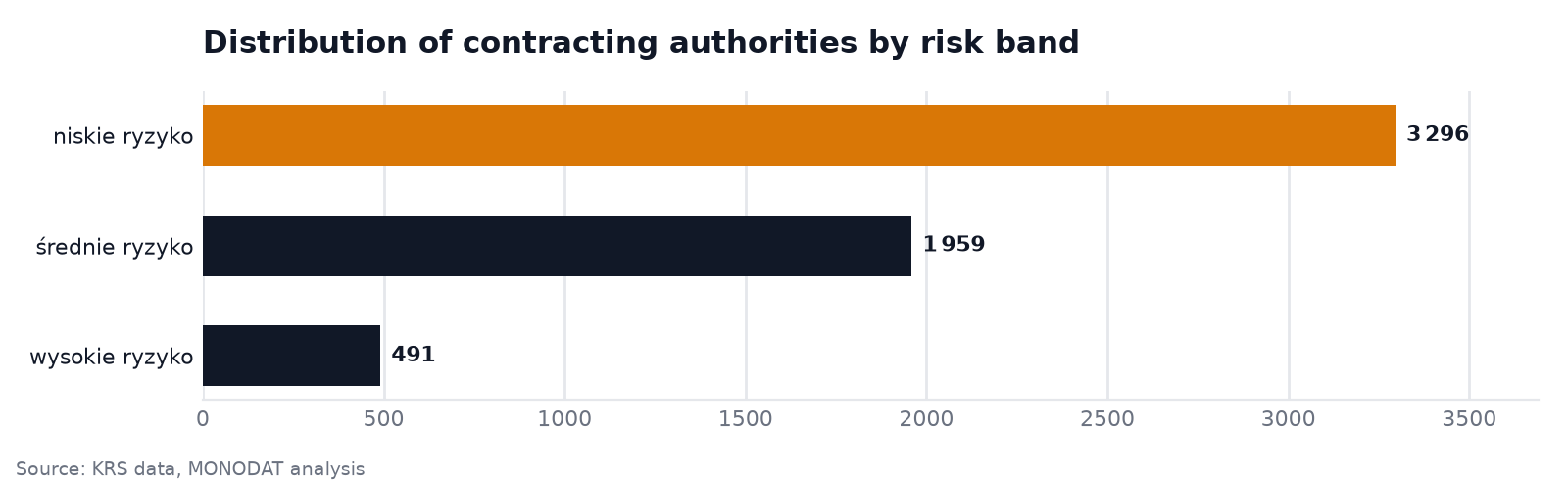
The dominance of the low-risk category aligns with Poland's ongoing efforts to harmonize its procurement practices with the highest standards of the European single market. Regular oversight by institutions such as the Public Procurement Office (Urząd Zamówień Publicznych) ensures that the baseline operating environment for the majority of these 3,296 entities remains transparent and accessible to entities registered across the EU.
The High-Risk Minority: Where Single Bidders and Concentration Dominate
Standing in stark contrast to the open market are the 491 contracting authorities flagged in the high-risk band. It is imperative to state that under the methodology applied to open procurement data (TED/BZP), this high-risk classification is a neutral, data-driven analytical signal regarding market concentration, not a legal accusation of wrongdoing, corruption, or intentional exclusion by any specific entity. Nevertheless, the aggregate metrics generated by this 8.5% subset paint a picture of severe competitive restriction.
Across the analyzed data, the average single-bidder rate stands at a highly elevated 30.0%. This means that in nearly one-third of all procedures evaluated in this context, the contracting authority received only one valid offer. For an international market of Poland's size, a 30.0% single-bidder average is a structural anomaly that compliance teams must factor into their risk models. When a government entity consistently receives only one bid, it functionally loses its ability to enforce price discipline, and the procurement process devolves into a localized monopoly.
Furthermore, the average winner concentration, measured by the Herfindahl-Hirschman Index (HHI), sits at 0.549. In standard antitrust and competition economics, an HHI above 0.250 is generally considered indicative of a highly concentrated market. An average HHI of 0.549 implies that a very small number of incumbent vendors—sometimes just one or two—are capturing the overwhelming majority of the contract value issued by these specific authorities.
Interestingly, the average share of non-competitive procedures (such as sole-source negotiated procedures) is remarkably low at just 3.0%. This is a crucial analytical insight: the extreme concentration is not happening because authorities are bypassing open tender rules. It is happening within ostensibly open, publicly advertised procedures. The barriers to entry are therefore not procedural, but practical.
Why do 8.5% of Polish contracting authorities exhibit such high vendor concentration?
The fact that severe concentration occurs primarily within open procedures suggests that the root causes lie in the pre-bidding phase. The high single-bidder rate (30.0%) and the extreme HHI (0.549) may result from several structural hypotheses rather than deliberate foul play.
One highly probable cause is the over-specification of technical requirements (SIWZ/SWZ). In sectors like specialized medical equipment, complex municipal IT architecture, or proprietary defense logistics, contracting authorities often write technical requirements that only the incumbent vendor can fulfill without incurring massive transition costs. This creates a natural lock-in effect. Even though the tender is published openly on platforms like Tenders Electronic Daily (TED), competing firms decline to bid, knowing they cannot meet the hyper-specific criteria.
Another hypothesis involves geographic isolation and the nature of the construction and waste management sectors. A localized contracting authority in a remote municipality may simply lack a broad pool of local contractors. If only one regional waste management facility has the physical infrastructure to service a specific county, the resulting 30.0% single-bidder rate is a geographic artifact, not a compliance failure. Finally, legacy IT systems often require ongoing maintenance and licensing that functionally prevent the authority from switching vendors, driving up the HHI organically over multiple procurement cycles.
Poland in the CEE Context: Assessing the 321 Billion PLN Market
When evaluating the national context, the contrast between the 3,296 low-risk authorities and the 491 high-risk entities defines Poland's positioning within the broader Central and Eastern European procurement landscape. The aggregated value of 321,352,857,427 PLN across 73,070 awards confirms Poland's status as the heavy-weight champion of CEE public spending.
However, the 30.0% average single-bidder rate observed in these concentration metrics serves as a vital benchmark. While the majority of the Polish market (57.4%) successfully avoids these pitfalls, the presence of an 8.5% high-risk tail requires international bidders to adopt a targeted approach. Compared to regional peers, Poland's sheer volume of contracts means that even a small percentage of high-risk authorities represents billions of Zloty in functionally closed ecosystems.
For foreign direct investors and M&A teams, the national context dictates a bifurcated strategy: aggressive bidding and expansion within the 57.4% low-risk majority, paired with extreme caution and deep-dive technical due diligence when approaching the 491 entities where incumbent vendors hold an HHI of 0.549.
Strategic Due Diligence: What to Watch Next
The data clearly delineates where the Polish public procurement market functions efficiently and where structural bottlenecks persist. For compliance officers, M&A analysts, and enterprise sales teams, the actionable takeaway is the necessity of pre-bid screening. Engaging in a resource-intensive bidding process with any of the 491 high-risk authorities—where the historical single-bidder rate hovers at 30.0% and the winner HHI reaches 0.549—is statistically likely to result in lost bid costs unless the bidder is the incumbent.
According to KRS data analyzed by MONODAT, cross-referencing corporate vendor structures with these high-risk contracting authorities can reveal hidden dependencies. If a target acquisition derives the majority of its valuation from contracts with high-risk public entities, that revenue stream is highly vulnerable to future regulatory audits or sudden shifts in technical specifications. Moving forward, the market should monitor whether the Public Procurement Office introduces stricter guidelines on technical specifications to artificially lower the 30.0% single-bidder rate. Until then, granular, data-driven intelligence remains the only reliable compass for navigating the 321.3 billion PLN Polish procurement landscape.